

🏎️ Getting ready #
⚠️ You will need an Ethernet cable and a laptop or PC with a Gigabit Ethernet port. Ethernet adaptors are available on sites like Takealot.
⚠️ If you have a 500Mbps or faster line, keep reading all the way to the App-Based Test section below or read our iPerf guide linked below.
⚠️ Openserve 1Gbps lines will show around 900Mbps when doing speed tests.
⚠️ Do not use the speed test inside Google search. Use Speedtest.co.za or Speedtest.net.
🧩 Why are cabled speed tests needed? #
We need cabled speed tests to rule out WiFi-related problems, and the fibre networks require these tests to open support tickets. Please view our Ethernet Testing Policy for more details.
🌍 Browser-based Speed test #
Step 1 #
Reboot your router and fibre box (ONT/CPE) and check they have stable power. Check your cabling and power adapters. Make sure everything is “clicked” into place, and
Step 2 #
Check if the lights on your fibre box (ONT/CPE) show an active fibre connection:
- Green ‘PON’ light for Octotel
- Green ‘Broadband’ light for Frogfoot
- Green ‘F’ or Orange ‘FX’ light for Vumatel
- Green ‘PON’ or similar for Openserve
Step 3 #
Connect a laptop directly to your fibre box (ONT/CPE) with an Ethernet cable. Check that there is a Gigabit link between the laptop and the fibre ONT/CPE. Usually the ONT will show a Green LAN light if there is a Gigabit link. If the LAN light is orange, it may be only a 100Mbps link.
⚠️ Make sure all VPN services are disabled.
Test your speeds at: https://speedtest.co.za
Openserve fibre customers can test with a laptop connected to the router or configure a PPPoE login on their laptop.
⚠️ 100Mbps Speed Limit #
When you see speed test results around 90Mbps, the problem is usually a router with 100Mbps Ethernet ports or a cable which is damaged or old. Check that the router has Gigabit ports and you are using a fairly new Ethernet cable (Cat5/Cat6 or better). An Orange LAN light on the fibre box (ONT / CPE) usually indicates a 100Mbps connection.
🐢 Slow Speeds #
If you still notice speed problems, please email our support team the following:
- Photo of your fibre box lights,
- Screenshot or photo of your speed test result (from speedtest.co.za)
- Details of which fibre network you are on, and your general location
- Summary of the problem, for example: “download speeds are slow in the evenings, but seem fine in the day” or “After Loadshedding I often notice the following problem…”
#
🏆 How to read a speed test result #
Here are two examples of speed test result screenshots:
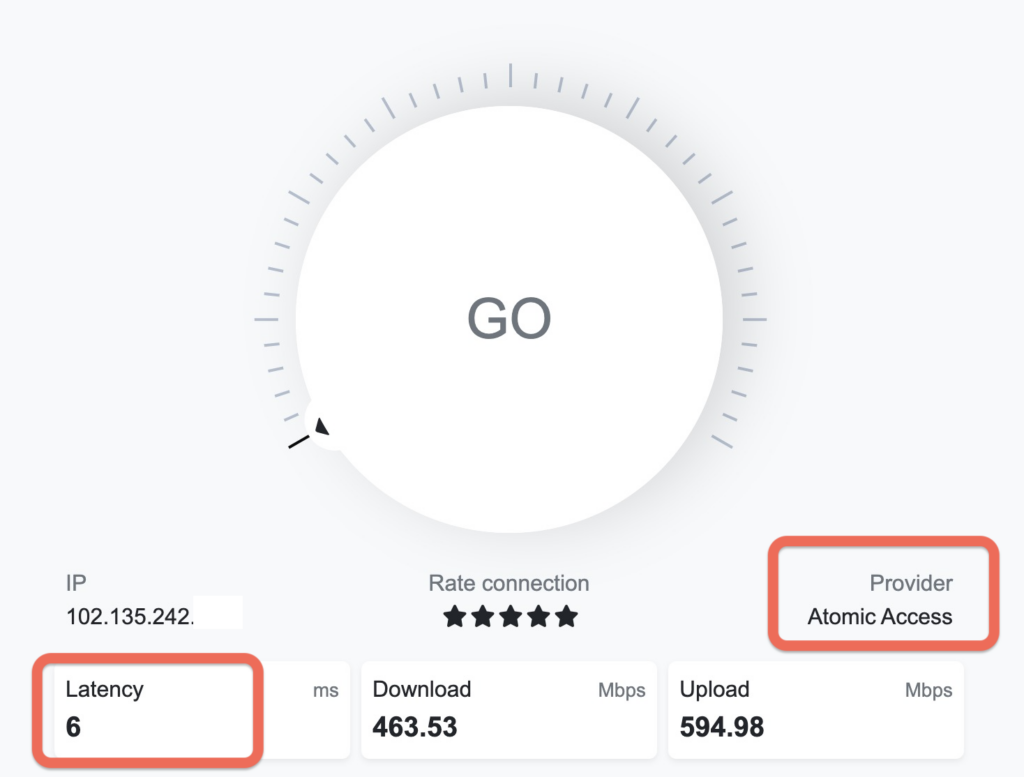
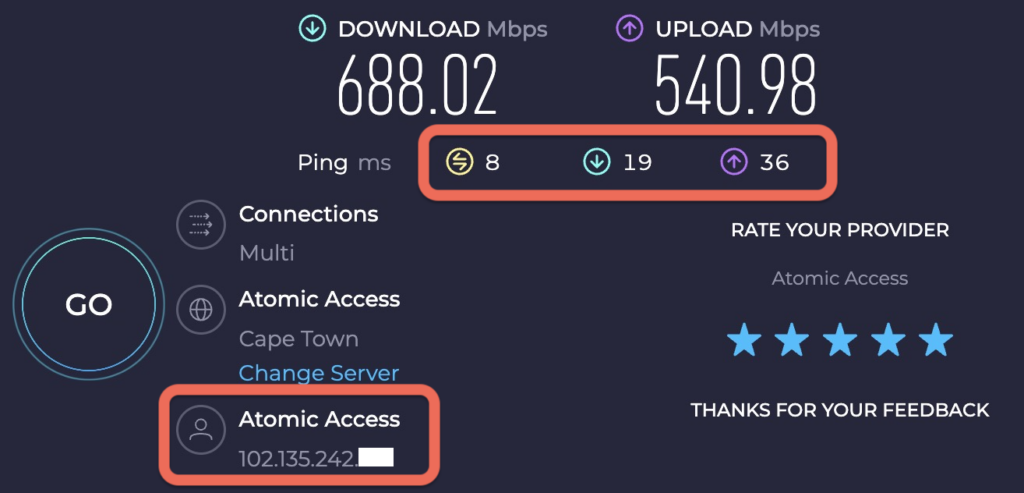
A speed testing service will usually show you the following in the result:
- Your IP address and the ISP name associated with this IP
- Download speed in Mbps
- Upload speed in Mbps
- Latency to the speed test server
Some speed test results will also show you:
- The speed test server name and location
- Latency under load in the download direction
- Latency under load in the upload direction
- Note: the latency under load numbers will always be higher than the unloaded latency numbers
When reading your result, please check the following:
- The IP needs to show the ISP name as Atomic Access
- If the Download speed is around 90Mbps, you could have a 100Mbps Ethernet limit
- If the latency to the speed test server is high (above 10ms) check that you are using a server in Cape Town, or that the latency makes sense for the speed test server city.
- If the latency under load numbers are high (above 50ms), this usually shows that a test is done over WiFi or the router could have buffer bloat problems.
Important:
- ISP name check: If the test result does not show Atomic Access as the ISP, you are probably testing over your mobile phone data, or you have a VPN active. We will need you to test again until you see Atomic as your ISP.
- Cabled test check: If your latency under load numbers are high, we will ask you to make sure you are doing a cabled test and not testing via WiFi. Our logs will show us if the MAC address changed when you tested with a laptop or PC directly in the fibre box (or if this did not happen and you were testing over WiFi).
🚀 App-Based Test #
⚠️ Browser speed tests often become unreliable above 300Mbps, and many speed test servers only have a 1Gbps connection.
If you are a Gigabit Fibre customer and are struggling to achieve fast speed test results, please install an app or use iPerf.
🚦 How to test with the Speedtest App #
✅ Using a Gigabit LAN port and Cat5/Cat6 Ethernet cable, plug a laptop or desktop PC directly into your fibre box. Openserve customers should configure a PPPoE login on a laptop.
✅ Install the Speedtest.net app (download) on your laptop or desktop and run a few tests. Select a server in Cape Town. Try a few different servers.
Keep an eye on your device’s CPU while you are running the tests to ensure your laptop/desktop is not saturating its CPU.
🏁 Speeds to Expect #
- Web-based speed test: around 800Mbps – not a very accurate test
- Speedtest.net desktop app: around 900Mbps – more accurate test
- iPerf3: up to about 950Mbps should be possible on a healthy line – accurate test
🤓 If you want to take your testing to the next level, consider our iPerf testing process.